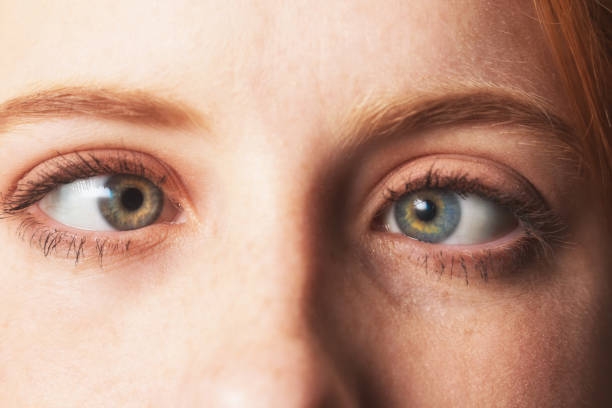
Inward turning (esotropia).
-reasons
-diagnostics
-treatment and complications in the absence of treatment
In addition to being a cosmetic defect, strabismus is also a more complex process associated with our brain. People who do not have an eye deviation look with two eyes, see the object at once, because the two images that appear in our eyes combine and form one image.
This connection is created by the brain, and the ability to connect is being improved until the age of 15, and for this reason, our eyes develop stereoscopic vision, ie 3D vision. These processes do not develop in children with a deviation, because one eye is distorted and that eye is extinguished, that is, it is no longer involved in vision.
Refractive errors cause visual impairment, and usually the higher the degree of weakness in the eye, the more the eye deviates. In this case, those around do not feel visual impairment in the child, because he has a vision. What is the visual acuity, the percentage of vision?
With 30-40% vision, a child can orient freely, pick up small objects, read, and in most cases never complain of poor vision. Therefore, even if your children do not have any eye problems, it is necessary to have an eye examination of all children at the age of one!
Of course, if strabismus occurs at 2,3,4 months, no need to wait until 1 year, and parents should immediately contact an ophthalmologist. After the onset of the disease, the sooner the patient referred to the doctor, the sooner strabismus can be cured. Over time, children already have tension in the eye muscles, and no conservative treatment helps anymore, and we have to operate.
Some patients do not choose the right course of treatment and waste their time with treatment of cerebral hypertension. It should be noted that there is no diagnosis of so-called cerebral hypertension, and cerebral pressure has no effect on the development of strabismus.
However, the patient or a close relative may complain that the strabismus occurred after a fall, high fever (fever), or vaccination. It should not be forgotten that every child falls, has a fever, is vaccinated, but not all of them develop eye deviations, because these factors do not play a key role in the development of strabismus. They just give a little more impetus to the already eye deviation.
Thus, the main factors in the development of strabismus are refractive errors. If the child feels more or less, periodic or regular strabismus, an eye examination is a necesseraly!
There are 3 main treatments types for strabismus:
1. Refractive correction (glasses)
2. Special orthoptic and diploptic treatments (by apparatus)
3. Surgical treatment
First of all, each treatment should consist of the exact refractive (glasses) correction. To do this, refractive errors must be accurately measured. That is, the degree of myopia, hyperopia, astigmatism and the axis of astigmatism (from 1 to 180 degrees is different in each child) should be determined.
If there is a difference of more than 4-5 degrees between the axis of astigmatism of the eye and the axis of astigmatism in the selected glasses, the glasses are considered inaccurate and this treatment may be wrong. Therefore, the exact correction of glasses is very important. To do this, refractive errors must be measured in several ways: with the help of special equipment and by retinoscopy (during retinoscopy, the doctor himself measures the refractive error).
It is relatively easier for children over 5-6 years old to prescribe accurate glasses, because in such children, refraction can be measured using a conventional stationary autorefractometer.
The correct position of the head and eyes is very important for a refractometer. Otherwise, measurements may be inaccurate if the patient tilts his head and does not look properly. Of course, such refractometers cannot be used in children under 1, 2, 3 years old. These children should use special children's refractometers.
With these refractometers, your child no longer needs to rest their chin on the device, rest their forehead, or look at a target. The refractometer measures at a distance of 1 meter without touching the eyes and provides accurate refractive error information in a few seconds.
After the prescribed spectackles, it is necessary to re-examine the patient after 1, 6 and 12 months. During this time, it is already known whether surgery is needed at later stages of treatment. If the eyes are in a symmetrical position (correct) with the glasses, and the eyes deviated only when the glasses are removed, then there is no need for surgical intervention. If the eyes are deviating while wearing glasses, surgery is needed.
If the eyes are twisted in turn, either right or left, then these eyes usually do not develop visual laziness due to deviation. If one of the eyes has more strabismus than the other and deviates more often, dysbinocular amblyopia, that is, visual laziness due to strabismus, occurs in the same eye. In the absence of regular examination and treatment, the patient develops incorrect fixation, ie no longer fixation with a macula (yellow spot), which is the center of the retina.
In such delayed cases, even with treatment, it is impossible to increase vision by more than 10%. That's why it is necessary to keep the eyes straight immediately after the strabismus occur, with the help of glasses (if it does not help – with help of surgery) to avoid such cases and complications. If the operation is performed at a late age, the eyes are cosmetically straightened, but vision may remain weak, the ability to connect to eyes is also can be weak, there is no volumetric vision, I.e the root of the internal distortion does not go away.
Surgery is one stage of treatment. After the surgery, treatment with glasses continues. The operation should be done early. Because if it is late, the above- mentioned stereoscopic vision, ie 3D vision, does not appear. If the child does not have a significant refractive error, visual acuity is 6/6 (20/20, 100%), fusion ability and stereo is present, then the child can be exempted from wearing glasses.
If the child has astigmatism, or high myopia, hyperopia, glasses should be worn until the age of 15. Because if not worn, visual impairment can occur. After the age of 15, the visual acuity of children treated in time is usually good even without glasses. If patients feel that their vision is better with glasses, then after the age of 18-19 the eximer laser surgery can be performed and they can be free from glasses for a few seconds.